
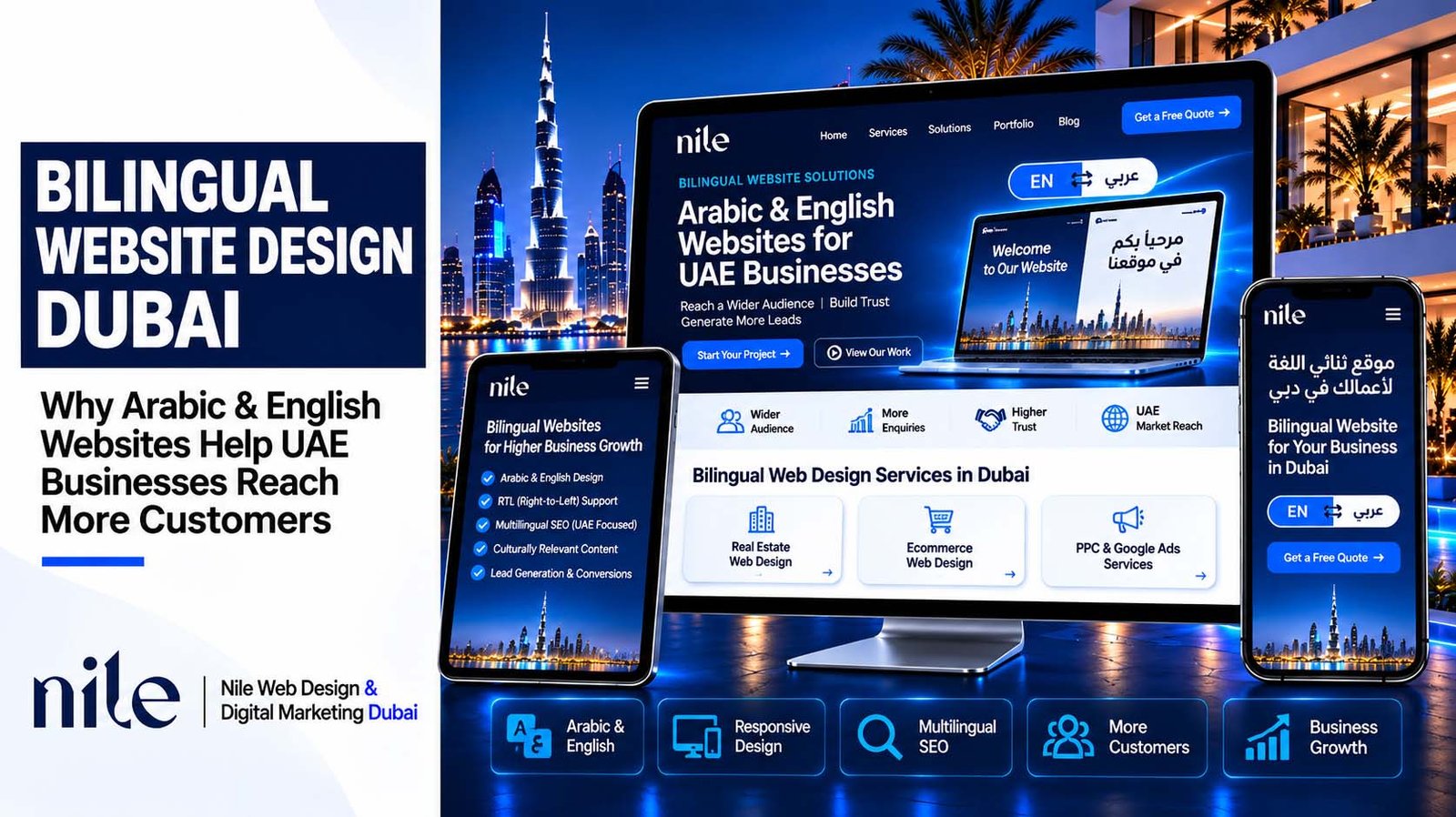
Dubai is home to a diverse business community where people from different countries, cultures, and language backgrounds interact every day. For businesses looking to attract customers across the UAE, providing information in more than one language can create a more accessible and welcoming online experience.
While English is widely used in Dubai’s business environment, Arabic remains the official language of the United Arab Emirates and an important part of communication with Arabic-speaking customers.
This raises an important question for business owners: Is an English-only website enough, or should your business invest in both Arabic and English website design?
For many businesses, a bilingual website can help communicate with a wider audience, improve customer understanding, and create additional opportunities for online enquiries and sales.
However, developing a bilingual website requires more than simply translating English text into Arabic. Businesses must also consider right-to-left layouts, navigation, search engine optimization, website performance, and cultural preferences.
At Nile Technology, we develop professional websites and custom digital solutions for businesses in Dubai and across the UAE. When planning multilingual functionality, we focus on helping businesses evaluate suitable content structures, responsive layouts, and user-friendly website experiences.
In this guide, we’ll explain why Bilingual Website Design Dubai is worth considering, how Arabic and English websites work, and what businesses should know before investing in multilingual website development.
What Is Bilingual Website Design?
Bilingual website design refers to developing a website that provides content and navigation in two languages.
For businesses in Dubai, this commonly means offering both English and Arabic versions of important website pages.
A professionally structured bilingual website allows visitors to select their preferred language and access the corresponding information without unnecessary confusion.
For example, an English-speaking visitor may browse your website using the English navigation menu, while an Arabic-speaking customer can switch to an Arabic version that displays translated content and a right-to-left layout.
A bilingual website may include:
-
Separate Arabic and English content.
-
A clearly visible language switcher.
-
Right-to-left support for Arabic pages.
-
Responsive layouts for both languages.
-
Language-specific page titles and descriptions.
-
Localized contact forms and navigation.
-
Appropriate multilingual SEO configuration.
-
Consistent branding across both versions.
The objective is to create an experience where visitors can understand your business, explore its services, and contact your team using their preferred language.
Why Arabic and English Websites Matter for Dubai Businesses
Dubai attracts businesses, investors, professionals, tourists, and residents from around the world.
Different customer groups may have different language preferences when researching services or comparing products online.
An English-only website may work well for some audiences, particularly companies serving international businesses.
However, organizations targeting Arabic-speaking customers may benefit from providing relevant content in Arabic.
1. Reach a Wider Audience Across the UAE
An English website primarily serves visitors comfortable browsing in English.
Adding Arabic content can make services more accessible to people who prefer reading and communicating in Arabic.
For example, a real estate company promoting residential properties in Dubai may attract international buyers through English pages while also serving Arabic-speaking buyers through localized property content.
A bilingual website does not guarantee additional traffic, but it can help a business serve customer groups that might otherwise find its content difficult to understand.
2. Improve Customer Confidence
Clear communication is an important part of building trust.
When potential customers can read service descriptions, pricing information, frequently asked questions, and contact instructions in their preferred language, they may feel more comfortable contacting the business.
This can be particularly useful for industries where customers need to understand detailed information before making decisions.
Professional Arabic Website Design Dubai should prioritize accurate communication rather than relying exclusively on automated translations.
3. Create a Better User Experience
A well-designed multilingual website makes navigation easier by providing accessible content and consistent layouts.
Arabic-speaking visitors should not have to translate every page manually.
Similarly, English-speaking customers should be able to return to English without losing their place on the website.
These small usability improvements can help create a more professional customer experience.
Arabic Website Design Requires More Than Translation
One of the biggest mistakes businesses make is assuming that Arabic website development only involves replacing English text.
Arabic has different reading and layout requirements.
English is generally displayed from left to right, while Arabic is written from right to left.
This difference affects the design and behavior of website elements.
Right-to-Left (RTL) Website Design
Professional Arabic RTL website design may require changes to:
-
Text alignment and content direction.
-
Navigation menu positioning.
-
Page layouts and content columns.
-
Form fields and labels.
-
Breadcrumb navigation.
-
Directional icons and arrows.
-
Buttons and interactive elements.
-
Spacing and typography.
For example, a website with a left-aligned English navigation menu may need a different arrangement for its Arabic version.
However, not every visual element should be mirrored automatically.
Logos, photographs, numerical information, maps, and certain interface icons may need to retain their original orientation.
An experienced web development team should evaluate these elements individually to preserve usability.
Arabic Typography and Readability
Arabic typography also requires careful attention.
Fonts should be readable across smartphones, tablets, and desktop computers.
Developers must consider line height, character spacing, font support, and text expansion.
A visually attractive English website may require adjustments when displaying longer or differently structured Arabic content.
The goal is to maintain professional branding while creating a comfortable reading experience in both languages.
How Bilingual Website Design Supports SEO in Dubai
Search engine optimization is one of the most important considerations when developing Arabic and English websites.
Google aims to show users relevant content based on their searches and language preferences.
Providing properly structured Arabic pages can create opportunities to appear for relevant Arabic-language searches.
Likewise, English pages can target appropriate English keywords.
However, multilingual functionality alone does not guarantee better search rankings.
Separate URLs for Each Language
Google recommends using separate URLs for different language versions of website content.
For example, a business may structure its website as:
English: example.com/en/services/
Arabic: example.com/ar/services/
This approach helps search engines discover and understand the language-specific pages.
Hreflang Implementation
The hreflang annotation helps search engines understand relationships between alternate language versions of a page.
For example, English and Arabic service pages can reference each other using appropriate language annotations.
This helps Google identify which version may be suitable for different users.
Hreflang does not automatically improve rankings, but it can support correct language targeting.
Language-Specific Keyword Research
An effective Multilingual SEO Dubai strategy requires separate keyword research for English and Arabic.
Directly translating an English keyword does not necessarily produce the most commonly searched Arabic phrase.
For example, English-speaking customers may search for “website design company in Dubai,” while Arabic-speaking customers may use different expressions to find similar services.
Businesses should research actual search terms, commercial intent, and local language preferences instead of assuming both markets behave identically.
Unique Meta Titles and Descriptions
Each language version should have relevant page titles, headings, meta descriptions, and visible content.
Arabic pages should feature natural Arabic copy rather than English keywords inserted repeatedly.
Proper localization helps visitors understand the page and supports clearer search relevance.
Bilingual Website Design for Real Estate Companies in Dubai
Dubai’s real estate industry serves local residents, international buyers, investors, property developers, and tenants.
Property websites often contain detailed information about locations, prices, floor plans, payment schedules, and available units.
Presenting this information in Arabic and English can make property discovery more convenient for different customers.
Multilingual Property Listings
A bilingual real estate website can provide property descriptions, project information, community details, and enquiry options in both languages.
For example, a developer launching an off-plan residential project may need to explain:
-
Property features and amenities.
-
Location and community information.
-
Available unit types.
-
Payment plans.
-
Project documentation.
-
Enquiry and viewing procedures.
The website should present accurate information consistently across both language versions.
Arabic and English Property Search
Property search filters should remain functional in both languages.
Visitors may need to filter by location, budget, property type, bedrooms, and availability.
The interface should support Arabic labels and suitable RTL layouts without reducing search usability.
At Nile Technology, our Real Estate Website Design Dubai services focus on professional property websites for developers, agencies, and brokers.
For suitable projects, bilingual content and language-specific functionality can be considered as part of the website’s development requirements.
A carefully planned bilingual property website can create a more accessible experience for Arabic-speaking and international audiences.
Why Ecommerce Businesses Should Consider Arabic and English Websites
Ecommerce websites require clear product information, convenient navigation, and trustworthy checkout processes.
Customers should understand what they are purchasing, how much it costs, and what happens after placing an order.
Language barriers can create uncertainty at different stages of the shopping journey.
A bilingual online store can address some of these challenges by offering relevant information in English and Arabic.
Localized Product Information
Product names, descriptions, specifications, and important policies should be understandable to the intended audience.
Professional translation can help customers compare products more confidently.
However, businesses must ensure that important details such as prices, sizes, product variations, and delivery conditions remain accurate.
Arabic-Friendly Shopping Experience
An Arabic ecommerce interface may require:
-
RTL product category navigation.
-
Arabic product filters.
-
Localized checkout fields.
-
Correctly displayed prices and currencies.
-
Translated shipping and return policies.
-
Arabic customer support information.
Businesses should test the entire purchasing journey rather than only translating the homepage.
WooCommerce and Shopify Multilingual Development
Popular ecommerce platforms such as WooCommerce and Shopify can support multilingual stores through appropriate configurations, applications, or development approaches.
The most suitable implementation depends on the platform, catalogue structure, translation management requirements, and integrations.
Nile Technology provides Ecommerce Website Design Services in Dubai for businesses planning professional online stores with user-friendly product presentation and ecommerce functionality.
For stores targeting both Arabic and English audiences, multilingual requirements should be discussed early in the project to avoid unnecessary redevelopment later.
Bilingual Website Design and Mobile Responsiveness
Mobile usability is important for businesses targeting customers in Dubai and across the UAE.
A website that works well in English on desktop computers may still experience layout problems when displaying Arabic content on smartphones.
Responsive bilingual development should therefore consider both screen size and language direction.
For example, a language switcher must remain accessible on mobile devices.
Arabic navigation menus should display correctly, while contact forms should provide suitable text alignment and input behavior.
Professional Responsive Web Design Dubai should also consider loading performance, accessible buttons, readable typography, and consistent interaction patterns.
Testing both languages on real devices can help identify problems that automated development tools may overlook.
The objective is to create an experience where customers can explore services comfortably regardless of their preferred language or device.
How Bilingual Websites Support Google Ads and Lead Generation
Businesses running Google Ads often create dedicated landing pages to match specific advertising campaigns.
When targeting audiences with different language preferences, separate Arabic and English landing pages may provide a more relevant experience.
For example, a property development company could create one English landing page and another Arabic landing page for the same project.
Each version would contain localized messaging, relevant calls to action, and accessible enquiry forms.
Language-Specific Landing Pages
An effective bilingual landing page should include:
-
Clear headlines in the selected language.
-
Relevant information matching the advertisement.
-
Easy-to-use enquiry forms.
-
Visible phone and WhatsApp options.
-
Appropriate trust-building information.
-
Mobile-responsive layouts.
The landing page language should align with the campaign’s audience and message.
Tracking Leads by Language
Businesses can also analyze performance separately for English and Arabic landing pages.
Useful measurements include:
-
Website visits.
-
Enquiry form submissions.
-
Calls and WhatsApp clicks.
-
Conversion rates.
-
Cost per lead.
-
Qualified sales enquiries.
This information can help marketing teams understand which campaigns and customer groups generate valuable opportunities.
Nile Technology also provides PPC Agency Dubai and Google Ads Services to help businesses plan targeted advertising campaigns, optimize landing pages, and measure customer enquiries.
Combining appropriate language targeting with effective website design can support a clearer and more accessible advertising experience.
WordPress vs Custom Development for Bilingual Websites
Both WordPress and custom-developed websites can support Arabic and English content.
The better approach depends on the project’s complexity.
WordPress Bilingual Websites
WordPress can be a practical option for corporate websites, service businesses, blogs, and many ecommerce stores.
Multilingual plugins and compatible themes can help businesses manage separate language versions.
WordPress may be suitable when the website primarily requires translated pages, service descriptions, blog content, and standard enquiries.
Custom Bilingual Website Development
Custom development may be more appropriate when a business requires advanced multilingual workflows, specialized dashboards, complex databases, or unique integrations.
For example, a customer portal with multiple user roles and extensive Arabic-English content management requirements may benefit from tailored functionality.
Both approaches require careful translation management, RTL support, testing, and multilingual SEO configuration.
Common Bilingual Website Design Mistakes to Avoid
Businesses should plan multilingual functionality carefully to prevent problems with usability and search visibility.
Using inaccurate translations: Automatic translation can produce awkward or misleading wording, particularly for specialized business terminology.
Ignoring RTL requirements: Arabic text alone does not make an interface fully RTL-compatible.
Translating only the homepage: Customers may become confused when service pages, forms, or checkout screens remain untranslated.
Using the same keywords in both languages: Arabic and English search behavior may differ, requiring independent keyword research.
Poor language switching: Visitors should be able to change languages without unnecessary redirects or losing access to relevant content.
Ignoring mobile testing: Both language versions should be tested on common screen sizes and browsers.
Inconsistent business information: Contact details, services, pricing, and policies should remain accurate across languages.
Avoiding these mistakes can create a more professional experience for customers.
How Much Does Bilingual Website Design Cost in Dubai?
Bilingual website development costs depend on the number of pages, translation requirements, design complexity, technology, and integrations.
A small corporate website with a limited number of Arabic and English pages will generally require less work than a large ecommerce store or property portal.
Additional costs may include professional translation, RTL interface adjustments, multilingual plugin subscriptions, custom functionality, quality assurance, and ongoing content maintenance.
Businesses should also consider future expenses.
For example, when adding a new service page or product category, both language versions may need updating.
Before starting development, request a quotation that clearly explains whether translation, multilingual SEO, Arabic design adjustments, and testing are included.
Why Choose Nile Technology for Website Design in Dubai?
At Nile Technology, we understand that every business has different customers, digital requirements, and long-term objectives.
Our website design and development services support businesses across Dubai and the UAE, including corporate organizations, ecommerce retailers, real estate companies, and professional service providers.
We focus on responsive website design, user-friendly navigation, practical functionality, SEO-friendly structures, and scalable development solutions.
For businesses considering bilingual website development, important planning areas include language selection, Arabic RTL compatibility, content management, translation quality, and technical SEO implementation.
Whether you are launching a new website or exploring improvements to an existing platform, Nile Technology can help you evaluate the development requirements and suitable technical options for your project.
Frequently Asked Questions About Bilingual Website Design Dubai
1. What is bilingual website design?
Bilingual website design involves creating a website that supports two languages, commonly Arabic and English for businesses in Dubai. Each language version should provide clear content, navigation, and appropriate layout behavior.
2. Why do Dubai businesses need Arabic and English websites?
Businesses targeting both Arabic-speaking and English-speaking customers may benefit from providing information in both languages. A bilingual website can improve accessibility, communication, and customer understanding.
3. Does an Arabic website improve Google SEO?
Arabic content can create opportunities to appear for relevant Arabic-language searches. However, rankings depend on content quality, technical SEO, competition, and other factors. Simply translating a website does not guarantee better visibility.
4. What is RTL website design?
RTL stands for right-to-left. It refers to the writing direction used for Arabic and certain other languages. RTL website design adjusts text, navigation, layouts, and suitable interface elements to support right-to-left reading.
5. Can WordPress support Arabic and English websites?
Yes. WordPress can support bilingual websites through suitable multilingual plugins, themes, and custom development. Translation management and RTL compatibility should be tested carefully.
6. How much does bilingual website design cost in Dubai?
Pricing depends on website size, translation requirements, RTL customization, multilingual SEO setup, and functionality. Businesses should request a detailed quotation based on their specific requirements.
7. Is an Arabic website necessary for every business in Dubai?
Not necessarily. The decision depends on your target audience. A company serving exclusively English-speaking customers may not need Arabic content immediately, while businesses serving a broader UAE market may find it valuable.
8. Can ecommerce websites support Arabic and English?
Yes. Many ecommerce platforms can support multilingual product catalogues, navigation, and checkout experiences. Implementation requirements depend on the platform, payment integrations, and translation workflow.
9. What is hreflang in multilingual SEO?
Hreflang is an HTML annotation that helps search engines identify alternate language or regional versions of a page. It helps Google understand which page version may be appropriate for different users.
10. Should Arabic content be translated manually or using AI?
AI translation can assist with the initial process, but important business content should be reviewed by qualified Arabic-language professionals. Human review is particularly valuable for legal, financial, technical, and customer-facing information.
11. Can bilingual websites generate more business enquiries?
They may help businesses communicate with additional audiences and reduce language-related barriers. Actual enquiry growth depends on website traffic, content relevance, usability, and marketing effectiveness.
12. Which company provides bilingual website design in Dubai?
Businesses should choose a development company with suitable multilingual technical expertise, RTL design capabilities, and SEO knowledge. Nile Technology provides website design and custom development services and can discuss Arabic-English functionality as part of a project assessment.
Final Thoughts: Is Bilingual Website Design Worth the Investment?
For businesses operating in Dubai and across the UAE, bilingual website design can be a valuable investment when their customers prefer different languages.
Providing professional Arabic and English website experiences can help businesses communicate more clearly, make information accessible to a wider audience, and support relevant search visibility.
However, successful bilingual development requires more than translation.
Businesses should consider RTL layouts, responsive design, language-specific SEO, content accuracy, technical performance, and ongoing maintenance.
The most effective approach is to understand your target customers and develop a website that meets their expectations.
Looking for Professional Website Design in Dubai?
Nile Technology provides website design, ecommerce development, real estate web design, and custom digital solutions for businesses across the UAE.
Whether you need a new corporate website, an ecommerce platform, or want to explore Arabic and English functionality, our team can help you discuss the appropriate development approach.
Visit Nile Technology – Web Design Dubai to explore our services and request a personalized project quotation.
Nile Technology — Connecting Businesses With Better Digital Experiences in Dubai and Beyond.