
For most people, your website is the very first thing they see before they ever pick up the phone or walk through your door. In a market as competitive as it is today, a tired, outdated site doesn’t just look bad — it quietly costs you customers, credibility, and revenue without you even realizing it.
Here’s the thing about websites: they age faster than most business owners expect. What looked sharp three or four years ago can feel dated today, simply because expectations, technology, and search engine algorithms never stop moving. The businesses that stay ahead are usually the ones that treat their website as something to maintain and improve, not something they build once and forget.
Whether you run a corporate firm, an online store, a real estate agency, or a startup trying to make a name for itself, the signs that your site needs work tend to look pretty similar. Let’s walk through the seven that matter most.
Nile — Web Design Company in Dubai, UAE
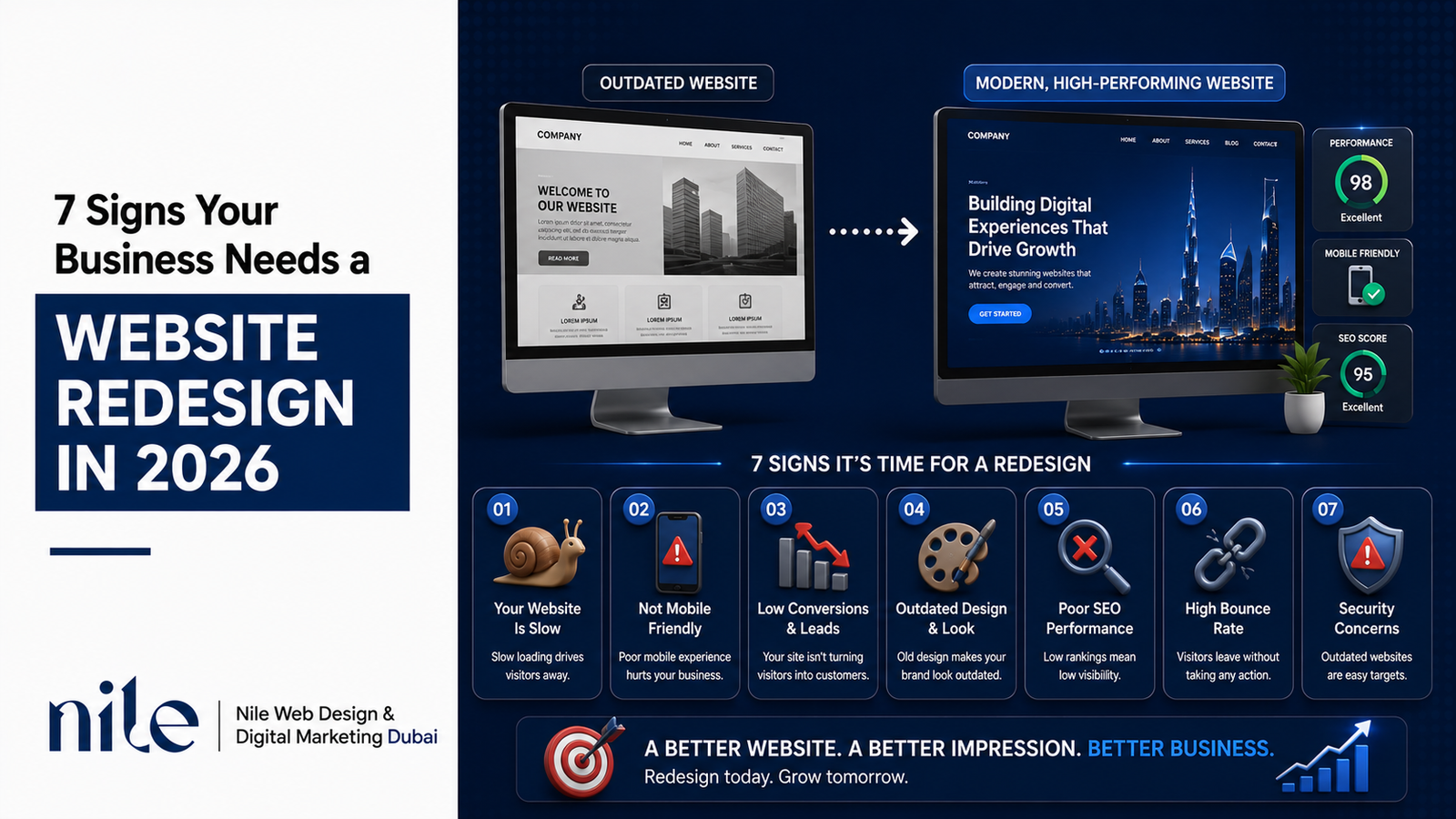
1. It Looks Outdated
People judge a website in seconds — and that first impression sticks. If your site looks a generation behind your competitors, visitors quietly assume the same about your business, even if that’s not fair.
You’ll usually spot the problem in a few places:
- Layouts that feel boxy or old-fashioned
- Small, low-quality images
- Typography that’s inconsistent or hard to read
- Branding that doesn’t match across pages
- Graphics that look dated
- A design that feels cluttered or busy
This is exactly why so many businesses turn to professional Web Design Dubai services — clean layouts, consistent branding, and an experience that feels intuitive rather than clunky. A redesign, done well, rebuilds trust the moment someone lands on your homepage.
2. It Doesn’t Work Well on Mobile
More people browse on their phones now than on desktops — that shift happened a while ago, and it’s not reversing. If your site breaks, stutters, or becomes hard to use on a phone, you’re losing customers before they even get to know what you offer.
Watch for these warning signs:
- Text that’s too small to read comfortably
- Buttons that are fiddly to tap
- Layouts that shift or break on smaller screens
- Pages that load slowly on mobile data
- Navigation that’s awkward with a thumb
Google also weighs mobile performance heavily in its rankings, so this isn’t just a user-experience issue — it’s an SEO one too. Good Web Design in Dubai puts responsive design at the center of everything, not as an afterthought.
3. It Loads Slowly
Speed shapes almost everything else about how your website performs. People don’t wait around for slow pages — they leave, often within a few seconds, and they rarely come back.
Slow sites tend to show up in the numbers as:
- Higher bounce rates
- Weaker search rankings
- Fewer conversions
- Frustrated, impatient visitors
Usually the cause is something fixable — unoptimized images, messy or bloated code, too many plugins stacked on top of each other, or hosting that simply can’t keep up anymore. A solid Web Development Dubai team will dig into these technical layers and clean things up so your site actually performs the way it should.
4. It’s Not Bringing in Leads
A website that just sits there looking nice isn’t doing its job. Its real purpose is to turn visitors into enquiries, leads, and eventually, sales.
If you’re getting traffic but barely any conversions, that gap usually comes down to one of these:
- Calls-to-action that don’t stand out or don’t say enough
- An experience that feels clunky or confusing
- Forms that ask for too much, too soon
- Navigation that makes people hunt for what they need
- A lack of trust signals — reviews, credentials, proof of work
Modern web design treats conversion as a design principle, not an afterthought bolted on at the end. Businesses that invest properly in this usually see a real, measurable lift in engagement and leads.
5. Your Content Is Hard to Navigate
People expect to find what they’re looking for quickly. If they can’t, they won’t dig around — they’ll just leave and try a competitor instead.
Common culprits include:
- Menus with too many options crammed in
- A page hierarchy that doesn’t make logical sense
- Broken or dead links
- Layouts that confuse rather than guide
- No search bar when one is clearly needed
A redesign gives you the chance to rethink how your content is organized from the ground up. And a well-structured site doesn’t just help your visitors — it helps search engines understand and rank your pages too.
6. It’s Holding Back Your SEO
Good SEO starts with a technically sound website. You can have great content and still struggle to rank if the foundation underneath it is shaky.
Typical technical issues include:
- Slow load times
- Poor mobile responsiveness
- Broken internal links
- Missing schema markup
- Duplicate content across pages
- Weak or inconsistent page structure
A thoughtful Web Design UAE approach bakes SEO into the build from day one rather than trying to patch it in later. Businesses that redesign around this usually notice real gains in organic traffic, keyword rankings, engagement, and lead flow — sometimes faster than they expect.
7. Your Competitors Simply Look Better
Sometimes the clearest way to judge your own website is to look at someone else’s. Ask yourself honestly:
- Does my site feel current, or a step behind?
- Is the experience smoother on theirs or on mine?
- Whose site loads faster?
- Whose content is more useful?
- If I were a customer, whose site would I trust more?
Across almost every industry, businesses keep raising the bar — better design, faster performance, sharper functionality, smoother experiences. Sectors like ecommerce website design in Dubai and Real Estate Website Design Dubai are especially competitive right now, with companies leaning hard into technology to capture more leads before their rivals do.
What You Actually Gain From a Redesign
A well-executed redesign isn’t just cosmetic. Done right, it delivers real, measurable results:
- A better user experience — modern layouts make information easier to find and browsing feel effortless.
- Stronger search rankings — technical fixes help search engines crawl, understand, and index your site properly.
- More leads — conversion-focused design nudges visitors toward actually taking action.
- A stronger brand image — a polished site quietly reinforces that you’re a business worth trusting.
- Better mobile performance — responsive design means your site holds up no matter what device someone’s using.
- Room to grow — modern frameworks make it far easier to add new features later without starting from scratch.
So, How Often Should You Actually Redesign?
There’s no strict rule here, but a good rule of thumb is every 2 to 4 years. That said, a full redesign isn’t always necessary — sometimes targeted updates to design, content, speed, or functionality solve the problem just fine.
If you’re nodding along to several of the issues above, though, a proper redesign is probably worth the investment.
Final Thoughts
Your website is still one of the hardest-working assets your business owns. As expectations and technology keep shifting, the sites that keep up are the ones that keep winning customers.
If your site looks tired, struggles on mobile, loads slowly, isn’t converting, or isn’t pulling its weight for SEO — that’s usually a sign it’s time for a change.
At Nile Technology, we help businesses build modern, high-performing websites that are built to deliver real results — not just look good.
Frequently Asked Questions
How do I know if my website needs a redesign?
If it looks outdated, loads slowly, struggles on mobile, or isn’t generating leads, those are usually the clearest signs it’s time.
How often should a business redesign its website?
Most businesses benefit from a review every 2–4 years to stay current and competitive.
Will a redesign actually improve my SEO?
Yes — it typically improves speed, mobile responsiveness, user experience, and technical SEO factors, all of which feed into better search visibility.
How long does a redesign usually take?
It depends on the scope, but most projects run between 2 and 8 weeks.
Can I redesign my site without touching the content?
You can, but pairing design changes with a content refresh almost always gives you better results.
Why does mobile responsiveness matter so much?
Because most people are browsing on their phones now, not desktops — and a site that performs well on mobile tends to perform better in search results too.