
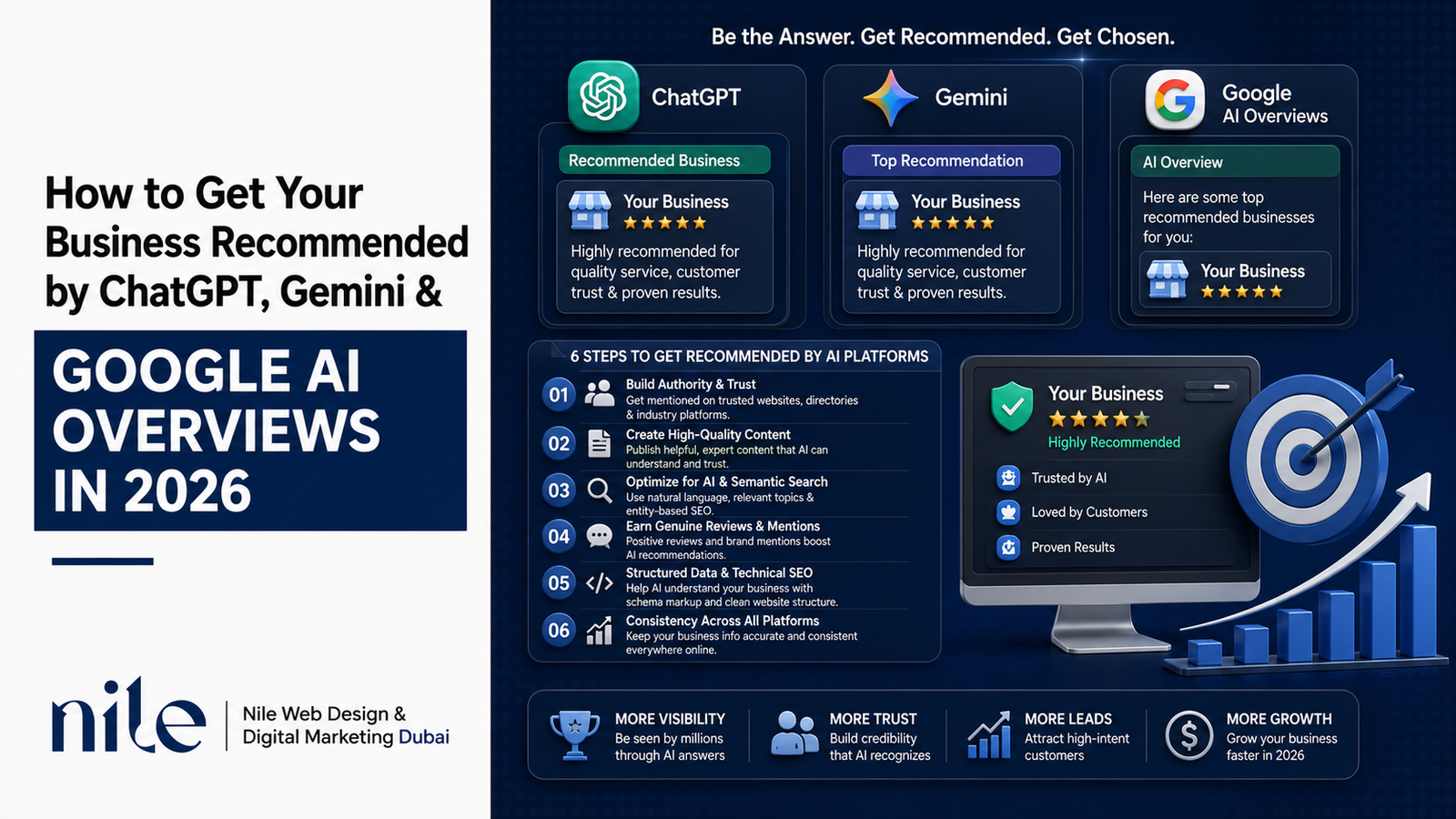
A few years ago, if you wanted to find a good web design company, a restaurant, or even a plumber, you’d type a few words into Google and scroll through a list of links. Today, that habit is quietly changing. More people are simply asking ChatGPT, Gemini, Claude, or Google’s AI Overviews directly — “Who’s the best web design company in Dubai?” — and expecting a clear, confident answer, not ten tabs to compare.
That shift leaves a lot of business owners asking the same question: “How do I get my business mentioned when someone asks an AI for a recommendation?” It’s a fair question, and it’s becoming an urgent one. If your business isn’t part of the answer an AI gives, you’re invisible at the exact moment someone is ready to make a decision, no matter how good your actual work is.
Old Search vs. AI Search: What’s Actually Different
Google’s classic search engine is built to rank pages. It looks at keywords, backlinks, and technical SEO, then hands you a ranked list.
AI search platforms work differently. Instead of ranking pages, they try to understand:
- Who you actually are as a business
- What you do, specifically
- Whether you can be trusted
- What real expertise you bring to the table
- How often (and how consistently) your brand shows up online
- Whether people genuinely find your content useful
In short: old search rewards optimization. AI search rewards genuine authority.
Say Clearly Who You Are and What You Do
A surprising number of business websites are vague. They talk about “solutions” and “innovative services” without ever saying plainly what the company does.
AI systems don’t fill in blanks the way a human reader might. If your website doesn’t clearly state it, the AI has nothing to reference.
Make sure your site clearly answers:
- What’s the company name?
- What services do you actually offer?
- What industry or niche are you known for?
- Where are you based?
- How long have you been doing this?
- What results have past clients seen?
For example, a company that plainly calls itself a web design company in Dubai gives AI tools a much stronger, clearer signal than one that just says it offers “digital services.” Specificity wins.
Publish Content That’s Actually Useful — Not Just More Content
AI models learn who to trust largely from the content a business puts out. Businesses that regularly publish genuinely helpful material tend to get referenced far more often.
Good content ideas include:
- In-depth guides for your industry
- Real case studies
- Expert opinions and insights
- Trend breakdowns
- Honest FAQs
- Practical how-to articles
Here’s the key mindset shift: this isn’t about publishing more. It’s about publishing better. One genuinely useful, well-researched article beats ten generic ones. Authority builds slowly, through consistency and quality, not through volume alone.
Build Real Service Pages, Not Just a Homepage
A lot of businesses lean entirely on their homepage and skip dedicated service pages. That’s a missed opportunity — and it limits how much AI (or Google) can understand about what you actually offer.
Instead, build out individual pages for each core service, such as:
- Website Design
- Web Development
- SEO
- Google Ads
- Branding
- eCommerce Solutions
- Real Estate Solutions
Each page should cover the service itself, its benefits, how your process works, which industries you serve, and answers to common questions. The more thorough and genuinely helpful each page is, the easier it becomes for an AI system to understand exactly what you’re good at.
Go Deep in One Industry, Not Wide Across All of Them
Businesses that specialize tend to outperform generalists. Someone searching for the best real estate website developers, for instance, is looking for a team that understands the specifics of that industry — things like:
- Property listing management
- CRM integrations
- Lead capture and management
- Property search functionality
- Agent dashboards
- Off-plan project pages
If you publish content and showcase projects focused on a specific niche, you build a much deeper, more credible layer of expertise than a company trying to be “everything to everyone.”
Let Your Case Studies Do the Talking
Case studies are some of the strongest trust signals a business can have. They prove — with evidence — that you’ve actually done the work, not just claimed you can.
A solid case study usually includes:
- Background on the client
- What they were trying to achieve
- The challenges they were facing
- How you solved it
- What results actually came out of it
AI systems (much like real people) trust evidence over marketing language. “We’re the best in the industry” means nothing without proof behind it.
Don’t Ignore User Experience
AI platforms increasingly favor websites that are genuinely pleasant to use. That means:
- Fast loading speed
- A site that works smoothly on mobile
- Clear, logical navigation
- Secure browsing (HTTPS, no shady pop-ups)
- Accessibility for all users
- Content that’s actually helpful, not filler
A site people enjoy using naturally earns better engagement over time — and that engagement becomes another signal of trust.
Build Your Brand Presence Beyond Your Own Website
AI tools tend to favor brands they recognize from multiple places, not just a single website. Strengthen your presence through:
- A complete, active Google Business Profile
- Regular social media activity
- Listings in relevant industry directories
- Genuine customer reviews
- Partnerships with other trusted businesses
- Guest articles on other reputable sites
- Press mentions where possible
The more consistently your brand shows up across the internet, the stronger and more credible your digital footprint becomes.
Specialize, Don’t Stay Generic
A generic website rarely stands out to anyone — human or AI. Businesses that clearly specialize get remembered.
For example, an agency offering eCommerce web design Dubai can build authority by publishing content around:
- Shopify development
- WooCommerce store builds
- Conversion rate optimization
- Payment gateway integration
- Mobile commerce experiences
- Overall customer experience design
Specialization tells AI systems exactly when and why your business deserves to be recommended.
Strengthen Your Trust Signals
Trust is at the core of every AI recommendation. The strongest trust signals include:
- Genuine customer reviews
- Real testimonials
- A visible portfolio of past projects
- Years of experience, clearly stated
- Easy-to-find contact information
- Detailed case studies
- Any relevant industry certifications
The more of these you have — and the more consistent they are — the easier it becomes for AI to treat your business as a credible, reliable source.
Think in Terms of “Entities,” Not Just Keywords
Modern AI search relies heavily on what’s called entity-based understanding. An “entity” is simply a clearly defined business, person, service, or organization that search engines and AI models can recognize consistently.
Your website should repeat the same clear signals everywhere:
- Company name
- Service categories
- Location
- Area of expertise
- Brand identity
When the same accurate information about your business appears consistently across multiple trusted sources, AI systems become more confident referencing you.
Don’t Underestimate Your FAQ Section
FAQs aren’t just a nice-to-have. They directly help AI platforms understand:
- What customers actually ask about your business
- What services you provide
- Where your expertise lies
- What people are really trying to find out
Well-written, specific FAQ sections often become direct source material for AI-generated answers. It’s worth updating them regularly based on real questions your customers ask.
Reviews Still Matter — A Lot
Reviews act as independent proof that you deliver what you promise. Strong reviews signal:
- Genuine customer satisfaction
- Consistent service quality
- Overall business credibility
Encouraging real customers to leave honest reviews on trusted platforms is one of the simplest ways to strengthen your reputation — both with people and with AI systems.
There’s No Shortcut to AI Visibility
A lot of businesses go looking for a quick trick to “hack” AI search. Honestly, there isn’t one.
What actually works is:
- Publishing consistently
- Creating genuinely valuable content
- Building a strong, recognizable brand
- Delivering a great user experience
- Demonstrating real expertise
- Playing the long game on trust
Businesses that commit to these fundamentals will keep benefiting as AI search continues to evolve.
Final Thoughts
AI-powered search is changing how people find businesses online, and that shift isn’t slowing down. Companies that invest in real expertise, quality content, a smooth user experience, and consistent brand authority are the ones setting themselves up for long-term success.
Instead of chasing rankings alone, focus on becoming the most genuinely helpful, trustworthy source in your industry. When your website consistently proves its expertise and delivers real value, platforms like ChatGPT, Gemini, and Google AI Overviews are far more likely to notice — and recommend — your business.
The future of search belongs to businesses that build real authority, publish content that matters, and earn trust the honest way.
FAQs
What is AI Search?
AI Search refers to platforms that use artificial intelligence to answer questions directly, instead of just showing you a list of web pages to click through.
How can businesses get recommended by ChatGPT and similar tools?
By publishing genuinely authoritative content, clearly demonstrating expertise, earning real customer reviews, and building a consistent, trustworthy online presence.
Does website design actually affect AI visibility?
Yes. How your site is structured, how it performs, the quality of its content, and its overall trust signals all shape how AI systems interpret and represent your business.
Why do case studies matter so much for AI search?
They provide real evidence of your expertise, rather than just marketing claims — and AI systems, like people, trust evidence.
Can small businesses compete with bigger names in AI search?
Yes. Business size matters far less than consistently publishing helpful content and clearly demonstrating real expertise.
How long does it take to improve AI visibility?
It’s a long-term effort, not an overnight fix. Consistent content, ongoing optimization, and steady trust-building typically pay off more over time.